Two Different Problems, Two Targeted Solutions
When homeowners in San Antonio contact White Brothers San Antonio Air Duct Cleaning, one of the most common questions we hear is: "Is sanitizing included in the duct cleaning, or is it something extra I actually need?" It's a fair question, and the honest answer is that these are two distinct services that target two different categories of problems — and for many San Antonio homes, both are genuinely warranted.
Let's break down exactly what each service does, why San Antonio's climate makes both particularly relevant, and how to determine which combination is right for your home.
What Air Duct Cleaning Actually Does
Professional air duct cleaning is a mechanical process. Technicians use high-powered negative-pressure vacuum systems — either truck-mounted or portable, depending on access — combined with rotating brush tools to physically dislodge and extract accumulated debris from inside your ductwork. That debris includes:
- Dust and particulate matter from daily living
- Pet dander and hair
- Construction debris from renovation work
- Insulation fibers from attic ductwork
- Pest droppings and nesting material
- Pollen and outdoor particulates that entered through the air handler
The key word is mechanical. Duct cleaning physically removes visible, tangible buildup from the interior surfaces of your supply and return ducts, trunk lines, and plenums. A properly performed cleaning leaves your duct interiors visually clean — which you can verify through the before-and-after camera inspection we include with every job.
What duct cleaning does not do is kill microorganisms that have already colonized your duct surfaces. If mold spores have established colonies on duct walls, or if bacteria have taken hold on damp surfaces near the evaporator coil, a vacuum and brush will remove the physical debris around them but won't necessarily eliminate the microbial contamination itself. That's where sanitizing comes in.
What HVAC System Sanitizing Does
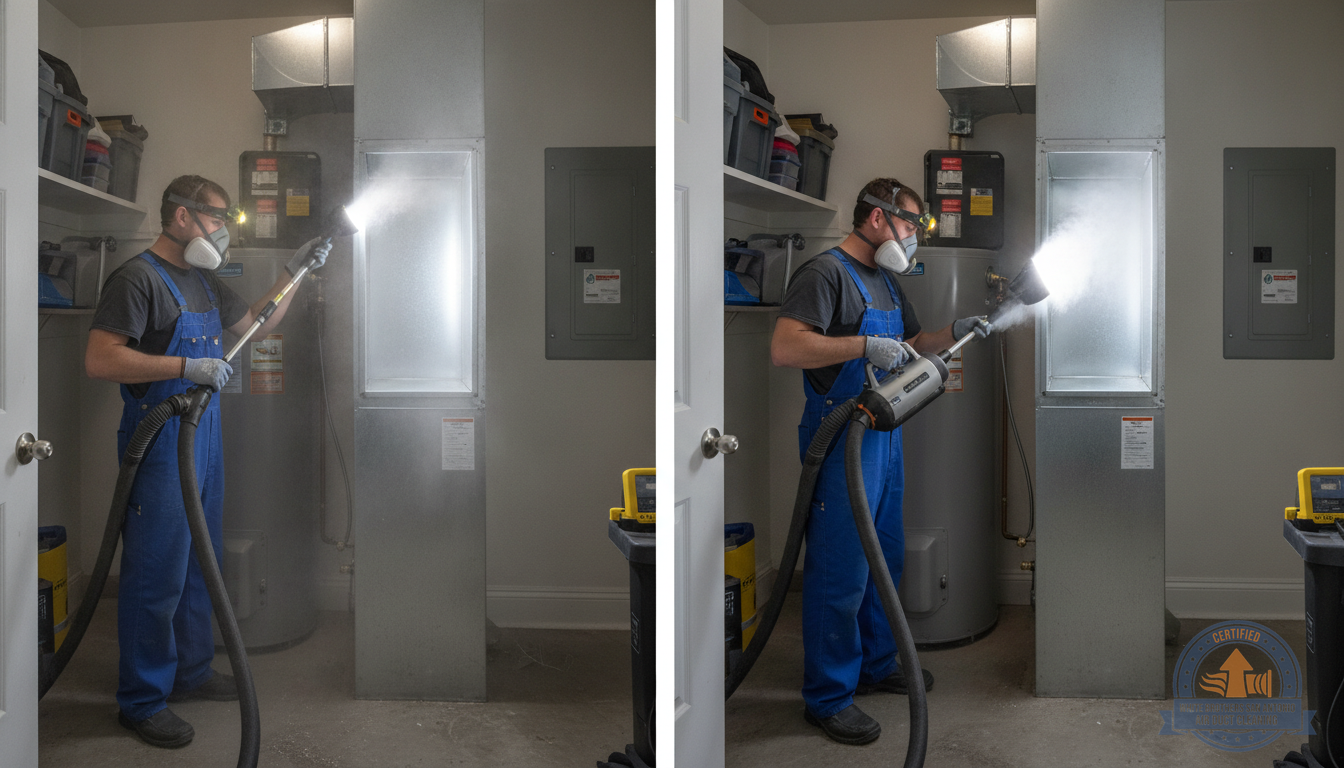
Our HVAC system sanitizing service is a chemical process that follows the mechanical cleaning. After your ducts have been cleaned and surfaces are free of dust and debris, our technicians apply an EPA-registered antimicrobial solution as a fine mist throughout the entire duct system. The solution coats interior duct walls, supply and return runs, evaporator coil surfaces, and the drain pan — all the places where biological contamination tends to thrive.
The antimicrobial agent does two things: it kills existing mold, bacteria, and odor-causing microbes on contact, and it leaves a residual protective barrier that inhibits future microbial growth for six to twelve months under normal operating conditions.
Importantly, sanitizing is only effective when applied to clean surfaces. Applying an antimicrobial solution over a layer of dust and debris is like painting over a dirty wall — the contaminant layer blocks direct contact between the solution and the surface you're trying to treat. This is why sanitizing should always follow duct cleaning, never replace it.
Why San Antonio's Climate Makes Both Services More Important
San Antonio sits in a climate zone that creates particularly demanding conditions for residential HVAC ductwork. Summers are long and intensely hot, with outdoor temperatures routinely exceeding 95°F from June through September. Attic temperatures during these months can reach 140°F or higher, causing flex duct materials to degrade faster and making any moisture that enters the duct system — from condensation, small leaks, or humid outdoor air — evaporate and then re-condense on cooler surfaces inside the air handler.
The result is a cycle of moisture exposure on evaporator coil fins, drain pans, and flex duct interiors that makes mold and bacterial growth an ongoing threat rather than a rare event. Homeowners in established neighborhoods like Alamo Heights and Terrell Hills, where homes are older and duct systems may have seen decades of use, face an even higher baseline risk of microbial contamination simply due to the accumulated exposure time.
For families with members who have asthma, seasonal allergies, or compromised immune systems, this combination of mechanical cleaning and antimicrobial treatment isn't a luxury — it's the medically sensible choice for maintaining a genuinely healthy indoor environment.
What About Evaporator Coil Cleaning — Where Does That Fit In?
If you're already investing in duct cleaning and sanitizing, evaporator coil cleaning completes the picture. The evaporator coil is the component inside your air handler where refrigerant absorbs heat from your home's circulating air. Over time, a thin film of dust, pollen, and biological matter coats the coil's aluminum fins, dramatically reducing heat transfer efficiency and creating a moist, contaminated surface that mold loves.
A dirty coil can cause your AC to run 15 to 25 percent longer per cycle to achieve the same cooling result, which translates directly into higher CPS Energy bills during San Antonio's extended cooling season. Cleaning the coil removes that insulating layer of grime, restores efficient heat transfer, and — when followed by sanitizing — eliminates the microbial reservoir that the coil's moisture environment tends to cultivate.
We recommend the full combination — duct cleaning, coil cleaning, and HVAC sanitizing — as an annual or biennial comprehensive service for San Antonio homes with known moisture history, pet ownership, or household members with respiratory sensitivities.
How to Decide What Your Home Needs
Use this simple guide to determine your starting point:
- Visible dust on registers, no odors, no respiratory symptoms: Duct cleaning alone is likely sufficient as a starting point.
- Musty odors when the AC runs or after the system has been off: Duct cleaning plus HVAC sanitizing is the appropriate combination.
- AC running constantly without reaching set temperature, or rooms that won't cool: Add evaporator coil cleaning to address efficiency loss at the source.
- Uneven room temperatures or hot/cold spots throughout the home: Consider adding duct repair and sealing to address leakage and airflow imbalance.
- All of the above: A comprehensive service visit combining all four treatments delivers the most thorough air quality restoration available.
Schedule Your San Antonio Air Quality Assessment Today
White Brothers San Antonio Air Duct Cleaning serves homeowners throughout Bexar County, including Leon Valley, Kirby, Alamo Heights, and communities near Lackland Air Force Base. We're available Monday through Sunday, 8:00 AM to 6:00 PM, and our technicians will walk you through a camera inspection of your duct system before recommending any services so you're never paying for work that isn't genuinely needed.
Call us at +17262234584 or email [email protected] to schedule your appointment. Our office is located at 4243 E Piedras Dr, Suite 102, San Antonio, TX 78228.
Confirm Availability
Call +17262234584 or fill out our online form for a free, no-obligation quote.
Request Free Quote